
.png)
Why Multi-Factor Authentication Matters More Than Ever
If you’re relying on just a password to protect your financial information, it’s no longer enough.
Even before the rise of AI-driven cyber threats, advances in computing power made it easier than ever for bad actors to crack passwords. Today, that risk is compounded by the fact that 73% of passwords are reused across multiple accounts, making them far easier to exploit. (Enzoic; ZDNet)
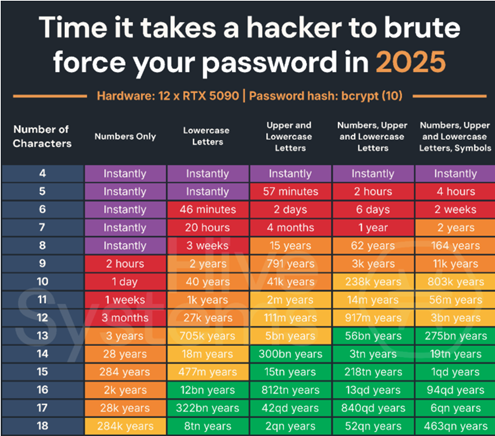
Source: Pegasus Technologies, “Password Security in 2025”https://pegasustechnologies.com/password-security-2025/
What Is Multi-Factor Authentication (MFA)?
Multi-Factor Authentication adds an extra layer of protection by requiring more than just a password to access your account.
It typically combines two or more of the following:
- Something you know: your password
- Something you have: your phone, authenticator app, or security token
- Something you are: biometric data, like a fingerprint or facial recognition
At Flatirons Bank, we focus on combining your password with a second factor, such as a mobile device or authentication tool, to help ensure secure access.
Why MFA Is Essential Today
Cybercrime continues to rise, and the financial sector remains one of the most targeted industries. In 2024, reported cybercrime losses exceeded $16 billion, a 33% increase year over year. The most common attacks included phishing, spoofing, and data breaches (FBI Internet Crime Report). As these attacks become more sophisticated, especially with AI automating phishing and credential theft, security measures must evolve as well.
MFA is one of the most effective protections available:
- It can prevent up to 99.9% of automated attacks (ZDNet)
- Research shows it can block over 99.99% of account compromise attempts (Microsoft)
Simply put, MFA is no longer optional, it’s foundational to protecting your financial information.
Not All MFA Methods Are Equal
While any form of MFA is better than none, some methods offer stronger protection than others.
Here’s how different MFA options compare:
-
Physical Tokens (Highest Security)
-
Extremely difficult to compromise
-
Not dependent on cellular or internet access
-
Less convenient to manage
-
-
Authenticator Apps (Strong Security + Convenience)
-
Generates secure, time-based codes
-
Not tied to email or SMS vulnerabilities
-
Requires setup and app management
-
-
Text and Email Codes (Convenient, but More Vulnerable)
-
Easy to use and widely accessible
-
More susceptible to phishing, SIM-swapping, and account compromise
-
Recent data shows a surge in business email compromise (BEC) and text-based phishing (smishing) attacks, reinforcing the risks associated with these methods (CrowdStrike).
Our Approach to Security
At Flatirons Bank, we encourage all clients to use Multi-Factor Authentication and to choose the most secure method that fits their needs.
While text-based MFA is a meaningful improvement over email, we strongly recommend using an authenticator app or a physical security token for stronger protection against evolving cyber threats. If not already set up, account holders can get authenticator app-based MFA set up on their account by calling the bank at 303.530.4999.
Security is not just a feature, it’s a core part of how we deliver an exceptional client experience. As a locally managed, relationship-focused bank, we take a proactive approach to protecting your accounts, your business, and your financial future.
If you have questions about MFA or would like guidance on selecting the right option for your account, our team is here to help.
The information in this article is based on industry research, government reports, and third-party cybersecurity analyses. Sources include:
-
Federal Bureau of Investigation (FBI), Internet Crime Report 2024, which reported over $16 billion in cybercrime losses in 2024. Available at: https://www.ic3.gov/AnnualReport/Reports/2024_IC3Report.pdf
-
Microsoft research on account security, indicating that multi-factor authentication can prevent more than 99.99% of account compromise attacks. Source: https://arxiv.org/pdf/2305.00945
-
CrowdStrike, Global Threat Report (2026), highlighting the rise in business email compromise (BEC) and AI-driven phishing attacks. Available at: https://go.crowdstrike.com/rs/281-OBQ-266/images/CrowdStrike-2026-Global-Threat-Report.pdf
-
Enzoic, Password Reuse Statistics, reporting that a significant percentage of users reuse passwords across accounts. Available at: https://www.enzoic.com/blog/8-stats-on-password-reuse/
-
ZDNet, Why Multi-Factor Authentication Is Essential, discussing the increasing importance of MFA in modern cybersecurity environments. Available at: https://www.zdnet.com/article/why-multi-factor-authentication-is-absolutely-essential-in-2025/
-
Pegasus Technologies, Password Security in 2025, illustrating password vulnerability trends and security risks. Available at: https://pegasustechnologies.com/password-security-2025/
Multi-Factor Authentication (MFA) enhances account security but does not guarantee complete protection against all forms of fraud or unauthorized access. Clients should remain vigilant against phishing, social engineering, and other cyber threats.
Flatirons Bank will never contact you to request your password, secure access codes, or authentication credentials. If you receive a suspicious request, please contact us immediately.
Flatirons Focus is authored and published by Flatirons Bank for informational purposes only. The opinions expressed in this blog represent the views of Flatirons Bank and are not intended as financial, legal, or accounting advice. Content on this blog may include information from third-party sources, which we consider reliable. However, we do not guarantee its accuracy or completeness. Links to external sites are provided for convenience and do not signify an endorsement by Flatirons Bank. Flatirons Bank is not responsible for the content, security, or privacy practices of linked websites.
All information on this blog is subject to change without notice. Content may become outdated due to market fluctuations, regulatory changes, or other factors. Readers should consult a qualified advisor for personalized advice tailored to their financial situation. For more details about our products and services, please contact Flatirons Bank directly.